Sit the real KS2 SATs papers online
Every maths and grammar, punctuation and spelling paper from 2016 to 2026, on screen with the real time limit, then marked and turned into a scaled score.
45 real papers from 9 years, with the official mark schemes.
Free, and you can start without signing up.
Name
Which years would you have passed?
Pick a year and start a paper
Nine years, newest first. Each year has three maths papers and two grammar, punctuation and spelling papers, so a pile of five books.
- 2026 SATs papers
- 2025 SATs papers
- 2024 SATs papers
- 2023 SATs papers
- 2022 SATs papers
- 2019 SATs papers
- 2018 SATs papers
- 2017 SATs papers
- 2016 SATs papers
maths grammar, punctuation and spelling
How a paper works here
The clock starts when you do and runs for the real time: 30 minutes for arithmetic, 40 for each reasoning paper, 45 for the grammar and punctuation paper.
- No calculator, as in the real test. Keep a pencil and paper for working.
- The spelling paper is read aloud, so turn the sound on.
- When the time is up, the paper is handed in and marked.
- The site marks an answer right or wrong only when it is certain. Anything it cannot be sure of, such as an unusual way of writing an answer, a drawing or an explanation, comes to you or another grown-up with the official mark scheme entry on screen, and you give the marks.
Finish every paper in a subject for one year and you get a scaled score. To turn a mark you already have into one, use the SATs scaled score converter.
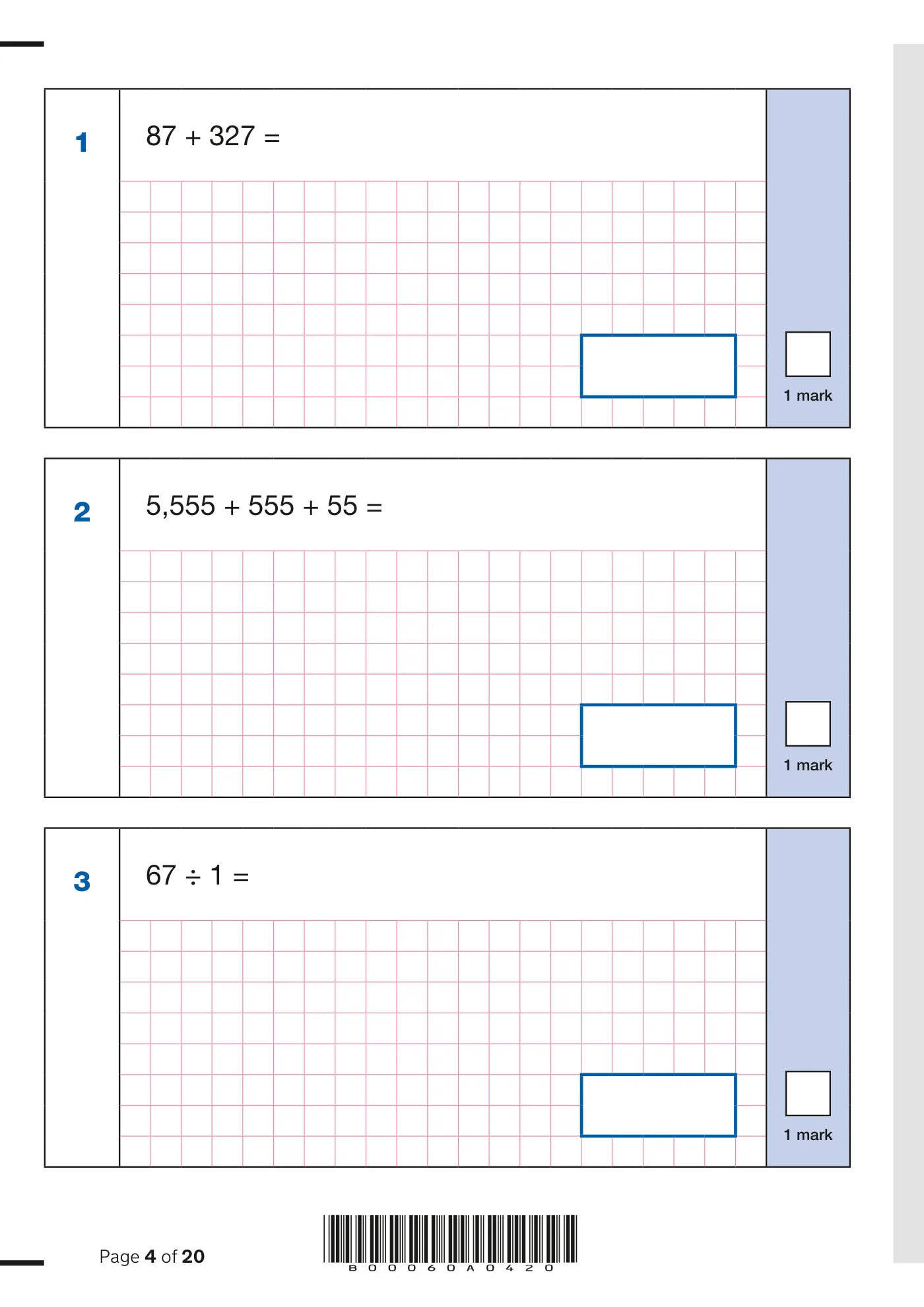
The five papers in every year
| Paper | Time | Marks |
|---|---|---|
| Maths Paper 1: arithmetic | 30 min | 40 |
| Maths Paper 2: reasoning | 40 min | 35 |
| Maths Paper 3: reasoning | 40 min | 35 |
| SPaG Paper 1: questionsSPaG: grammar, punctuation and spelling | 45 min | 50 |
| SPaG Paper 2: spellingRead aloud, by the tablet or a grown-up | About 15 min | 20 |
Which years would you have passed?
Finish all the papers for a subject in one year and you get that year's scaled score. 100 or more means you would have met the expected standard that year.
Each year is worked out with its own official table, so a child who sits several years can see where they would have got there and where they fell short. A gold star goes on every year that reached 100.
| Year | Maths | Grammar, punctuation and spelling |
|---|---|---|
| 2026 | 1 of 3 papers done | Not sat yet |
| 2025 | 10371 out of 110, met the expected standardStandard met | 4 answers for a grown-up to mark |
| 2024 | 9847 out of 110, below the expected standardBelow standard | 10444 out of 70, met the expected standardStandard met |
What is included and what is not
Maths and grammar, punctuation and spelling, 2016 to 2026. No reading papers, and no 2020 or 2021, because the tests were cancelled in both years.
Parts of the reading texts and pictures belong to other publishers, so we cannot put them on screen. The reading papers are free to download from GOV.UK past test materials.
SATs Rewind is not an official site and is not connected to the Department for Education or the Standards and Testing Agency.
Questions parents ask
Short answers. The longer ones are on the pages linked.
- Is it free?
- Yes. Every paper is free to sit, and the scaled score converter is free too.
- Is this the real paper?
- Yes. Each one is the paper Year 6 sat that May, published by the Standards and Testing Agency, with the same questions, order, marks and time limit.
- Is the score official?
- No. It uses that year's official conversion table, but it comes from a practice sitting at home, so read it as a good estimate. How scaled scores work
- What do you keep about my child?
- Without an account, nothing leaves your device. With one, a child is a nickname, a colour, a school year and their marks: no surname, birthday, school or photo. Privacy
- Do I need an account?
- No. Your child can start a paper straight away. A parent account is there if you want results saved for more than one child, on any device.
- What if my child runs out of time?
- The paper is handed in as it stands, as it would be in the hall. If your child has extra time at school, a grown-up can add it before the clock starts, and the clock can be hidden.
- What is a pass?
- There is no pass mark as such. A scaled score of 100 or more means the expected standard was met, and that is what most people mean by a pass. Scaled scores and the marks needed each year